
 Back
Creative Talk with Alexis Jamgotchian
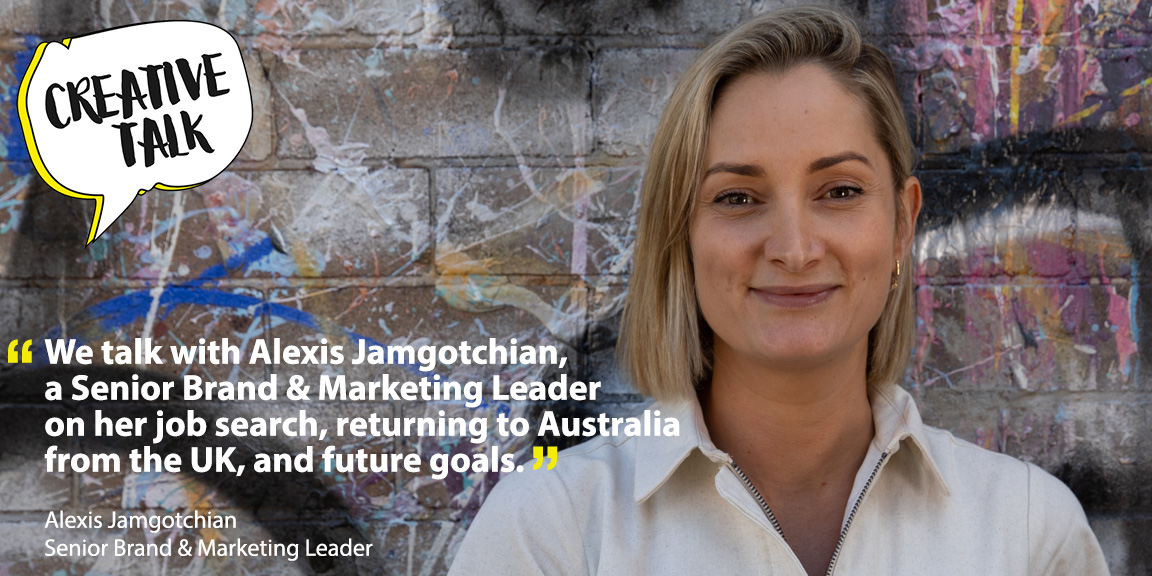
This month we talk with Alexis Jamgotchian, a Senior Brand & Marketing Leader, about her job search, returning to Australia from the UK, and future goals.
Tell us a bit about you.
I’m a brand and marketing leader with 19 years across agency and client-side roles, mostly in automotive. I started in Sydney at Saatchi & Saatchi on Lexus, then moved client-side to Lexus Australia as National Retail Marketing Manager. In 2012, I moved to London. I spent 13 years there on Volkswagen and Nissan at Adam & Eve DDB, TBWA, Tribal Worldwide and RAPP, and finished up working with Volkswagen’s global HQ in Germany. I came home in 2025 to join Innocean as Head of Marketing Transformation. My work sits where marketing, data, content and technology meet. Outside work, you’ll find me teaching dance fitness on the Northern Beaches on weekends.
What prompted your decision to return to Australia, and how are you feeling about stepping back into the local market?
Sydney’s always been home, and after 13 years in London it felt like the right time to come back. I’d spent years helping Volkswagen and Nissan join up their measurement, teams and content, and I could see Australian brands starting on the same journey. Coming home meant I could put that experience to work here, and I did that straight away at Innocean.
Stepping back in has been a mix of excitement and adjustment. The market is smaller and more connected than London, so relationships matter even more, and it’s been great reconnecting with people from before I left. Since my role at Innocean finished in September, I’ve been looking for my next one, and honestly I’m feeling really positive. So much is changing here, especially with AI, and it feels like a great time to be back.
Having worked across both markets, what do you think Australian brands and marketers do particularly well, and where could we learn a thing or two from the UK?
Australian marketers are brilliant at doing a lot with a little. Teams and budgets are smaller, so people are close to the work, quick to make decisions and great at ideas that punch above their weight. We’ve also got a great sense of humour and a sharp read of culture.
Where we can learn from the UK is in joining things up. Over there, performance measurement is built in from day one rather than bolted on at the end. Brands have one view of what’s working across every channel and act on it week to week, not in a wrap-up deck after the campaign. On Volkswagen UK, that shift gave the business its first real view of activity ROI.
UK teams have also done more to break down the silos between brand, performance, data and creative, so they plan and measure together instead of handing work over the fence. And they’ve moved faster on automating repeatable work like content versioning, reporting and insight, increasingly with AI. That frees people up for the thinking that really needs a human.
Australia is catching up fast. With our speed and creativity, we’ll be in a great position once those foundations are in place.
What’s been the biggest surprise about the Australian marketing landscape since returning?
How quickly AI has gone from a side conversation to the main one. I expected to find Australia a step behind the UK, but on AI the gap is closing fast. Brands here are curious, willing to test and moving quickly. What’s surprised me more is that the excitement is often running ahead of the foundations. AI is only as good as the data and measurement behind it, so the brands that get those right first will get the most out of it.
Do you think international experience is genuinely valued by Australian employers, or is there still a preference for candidates with recent local experience?
Honestly, both. People are really interested in the London experience, especially working with a global HQ and seeing how a big brand runs content and measurement across markets. But recent local experience still carries a lot of weight, particularly at the screening stage. I’ve found it helps to lead with what I’ve done since coming home and treat the international experience as the extra layer. The best conversations happen once you’re in the room.
As a senior brand and marketing leader, how have you found navigating the Australian job market?
Busy, and a real education. There are fewer senior roles than a few years ago and lots of great people going for them, so you have to be clear about where you add value. I’ve looked across client-side, agency and retail media roles and tailored every application properly. Networking has made the biggest difference: catching up with old colleagues and saying yes to coffees, panels and introductions. My best conversations have come from people, not job boards.
What’s been the most frustrating or surprising part of the recruitment process?
How long processes can take, and how often things change midway, with roles paused and briefs shifting between rounds. A quick “no” is always better than silence. The surprise has been take-home tasks. They’re fair enough, but they add up when you’re doing several at once, so I’d love to see more businesses keep them short and share feedback.
Do you think the expectations placed on senior marketing leaders have changed, and are businesses being realistic about what one person can deliver?
They’ve definitely changed. Many senior roles now ask for brand, performance, CRM, data, content, AI and team leadership in one person, often with a smaller team and budget. I don’t think the answer is finding a unicorn. It’s building the system around the role: connected data, clear measurement, good partners and teams that work together rather than in silos. One person can’t do everything, but they can set things up so the whole team delivers more.
Are employers overlooking experienced marketing leaders in favour of candidates who appear more digitally and AI savvy or come with a lower salary expectation?
I don’t think it’s as simple as experience versus AI. Most employers want both: someone who’s been through enough launches, campaigns and restructures to make good calls, and who’s genuinely curious about new tools. The onus is on experienced leaders to show we’re hands-on, using AI day to day rather than just talking about it. On salary, I get that budgets are tight. But the right senior hire should pay for themselves through better decisions, stronger teams and more value from agencies and partners.
If you weren’t to be working in brand and marketing, what would be your dream vocation?
Something in fitness. I start every day with a workout and teach dance fitness on weekends, and the buzz from a full class is hard to beat. If marketing wasn’t my thing, I’d be doing that full-time.
You have spent your career helping brands tell their stories. If you had to write the tagline for this next chapter of your own life, what would it be?
Still curious. Still learning. Still giving it a go.
I’ve never been very good at sitting still. I packed up and moved to London in 2012, came home 13 years later, and now I’m working out what’s next. Not every test works, in marketing or in life, but every one teaches you something. Whether I’m in a meeting room or teaching a dance fitness class on the weekend, it’s the same approach: give it a go, see what lands, and go again.
Last thoughts?
Marketing is changing faster than at any point in my career. Customers are researching and deciding with AI; those answers lean on independent reviews more than brand messaging, and brands are selling direct through channels like Amazon and TikTok Shop. It’s a really exciting time to be in this industry, and I’d love to be part of a team working it out. If that sounds like you, let’s grab a coffee.